Spectral Sensitivity of Photographic Materials
The classic Weston exposure meter is sensitive to light outside the range of the visual spectrum.
Data for the following graph was originally published by the Weston Electrical Instrument Company.
The shows the spectral sensitivity of the Weston cell used in this exposure meter.
|
 Spectral Sensitivity Range of the Exposure Meters
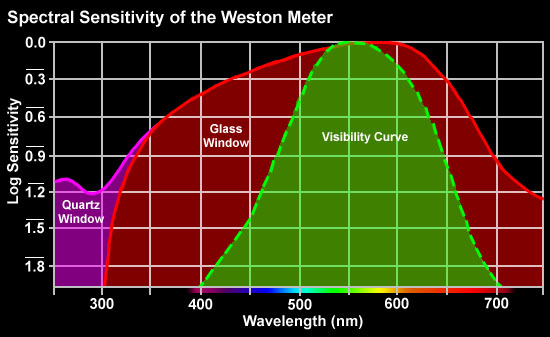
| If the Weston meter is fitted with a glass cover nearly all of the ultraviolet light below 300 nm is filtered out. A quartz cover allows limited sensitivity to below 250 nm. Sensitivity is down by about 4 f-stops in both the ultraviolet (250 nm) and the infrared (750 nm) regions. This makes it possible to use a photographic exposure meter to determine exposure settings for photography beyond the visual spectrum. Testing is required to determine an adjusted film speed setting to use for either ultraviolet or infrared exposure determination. The film speed adjustment should be about 4 f-stops plus some extra compensation for the UV or infrared passband filter placed over the Weston cell to eliminate other portions of the spectrum. |
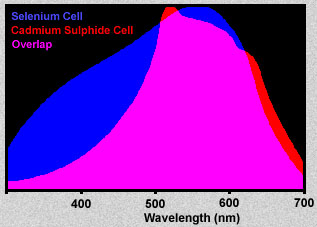
| The following illustration compares the spectral ranges for a selenium cell and a cadmium sulfide cell. The selenium cells is a better match for the visual spectrum and for ultraviolet. (This selenium sensitivity curve does not exactly match the one shown above for the Weston meter which uses a selenium cell.) The cadmium sulfide cell is better for infrared measurements than the selenium cell. Its sensitivity curve extends further into the infrared region. |
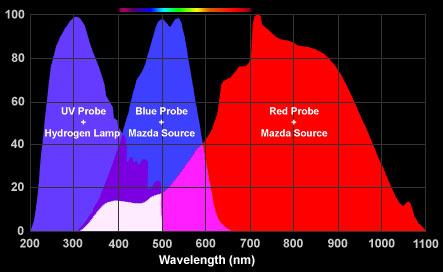
| Traditional photo multiplier tubes and newer semiconductor sensors have sensitivity bandwidths which cover the entire range of wavelengths of interest with photography. The following plot show the sensitivity range of the Densichron densitometer which uses a photo multiplier tube. |